
Where Does Physical Reality Draw the Line Around a “Self”?
Why minds, quantum computers and AIs all face the same geometric limit

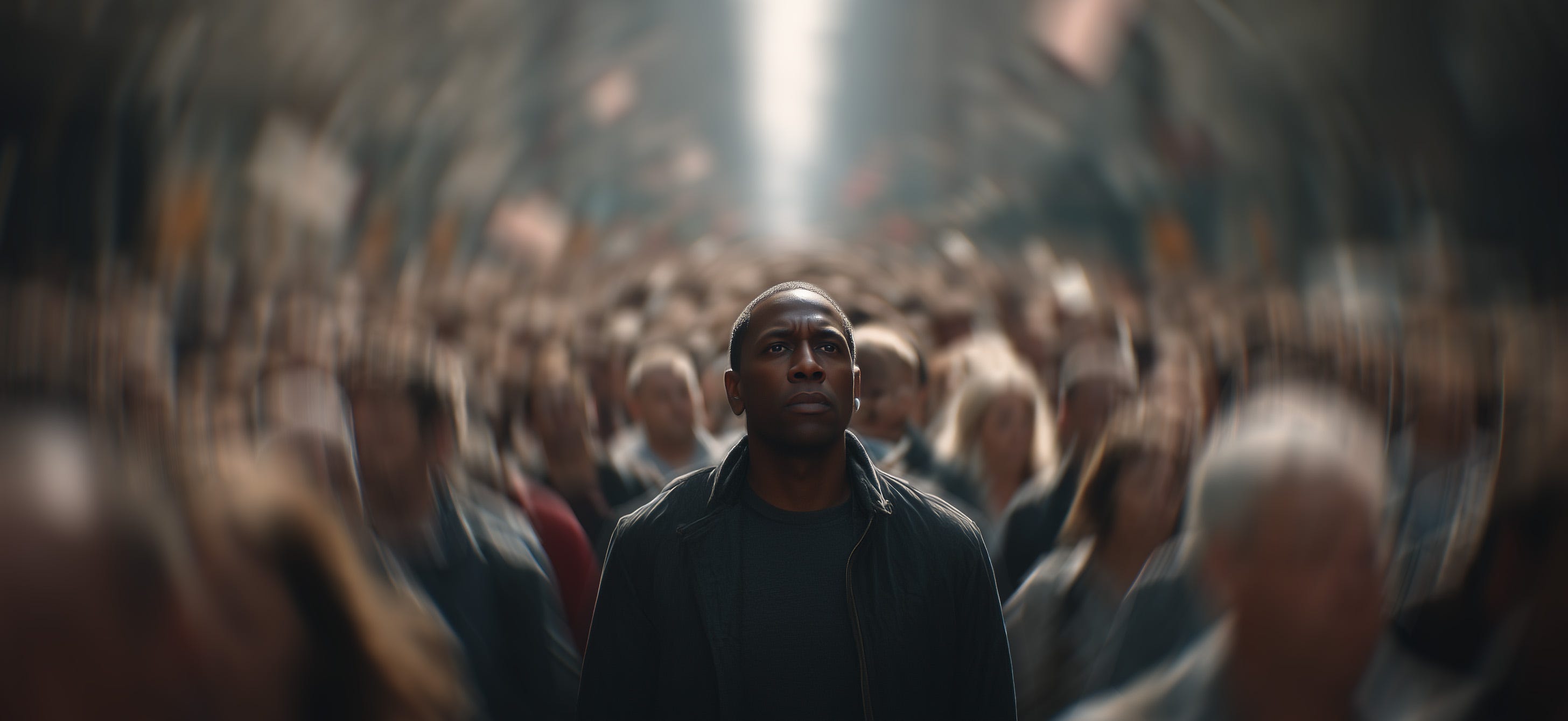
Your mind isn’t just what your brain does; it’s limited by how fast your brain can close its own loops of thoughts and reactions, and physical reality sets the limit. Consciousness in the classical universe ends where the echo can’t return in time.
This is the latest discovery after deepening a previous piece where I asked a very specific question: could a single mind literally split in two crossing a black hole’s event horizon, simply because some of its signals could no longer make the round trip? The technical companion paper on arXiv turned that thought experiment into a general constraint for any theory tying conscious unity to fast, three-dimensional information flow.

Once spacetime imposes a one-way boundary, like an event horizon or an accelerating cosmological edge, those loops cannot span it, no matter how intact the substrate remains on either side.
This article widens the lens again: not just ‘Does a mind split at the horizon?’ but ‘Where in the universe can anything, a brain, a distributed AI, a quantum computer, count as one unified self at all?’
A self as a system that can finish its own sentence
Many scientists and philosophers now picture a conscious subject not as a glowing substance in the head, but as a pattern of ongoing interaction that doesn’t stop at your skin.
Stated simply: a system counts as a single ‘self’ when its parts are locked in tight, ongoing conversation, constantly exchanging signals, folding each other’s responses into what happens next. Different theories dress this up in different terms (’integrated information’, ‘global workspace’, ‘predictive processing’), but they all share the same basic picture: a unified subject is what you get when components link through feedback loops that close quickly enough to stitch a common ‘now’ together. The speed matters because without it, there’s no shared moment, no single perspective threading through time.
Think of a band playing in time. If the musicians are close enough that everyone hears everyone else with only a tiny delay, the group acts as a single musical agent: a mistake in the drums gets corrected by the bass, a new idea in the guitar gets picked up by the keyboards, and the whole song flows as one performance.
Each player responds to the others fast enough that they can stay locked into the same groove, the same unfolding musical idea. The feedback loops close before anyone drifts out of sync.
Stretch those same musicians across a continent with seconds of delay, and something crucial disappears. For musicians, it’s synchronicity. For the mind, it’s coherence.
People are still playing notes at each location, still following the same sheet music, still technically part of the same project. But there’s no longer one band in any meaningful sense. The guitarist hears the drummer’s rhythm from three seconds ago and tries to adjust, but by the time that adjustment travels back, the drummer has moved on. Each location is making music, but they’re not making music together. The difference isn’t in the instruments or the musicians’ skill. It’s whether the loop can close fast enough to sustain a shared performance.
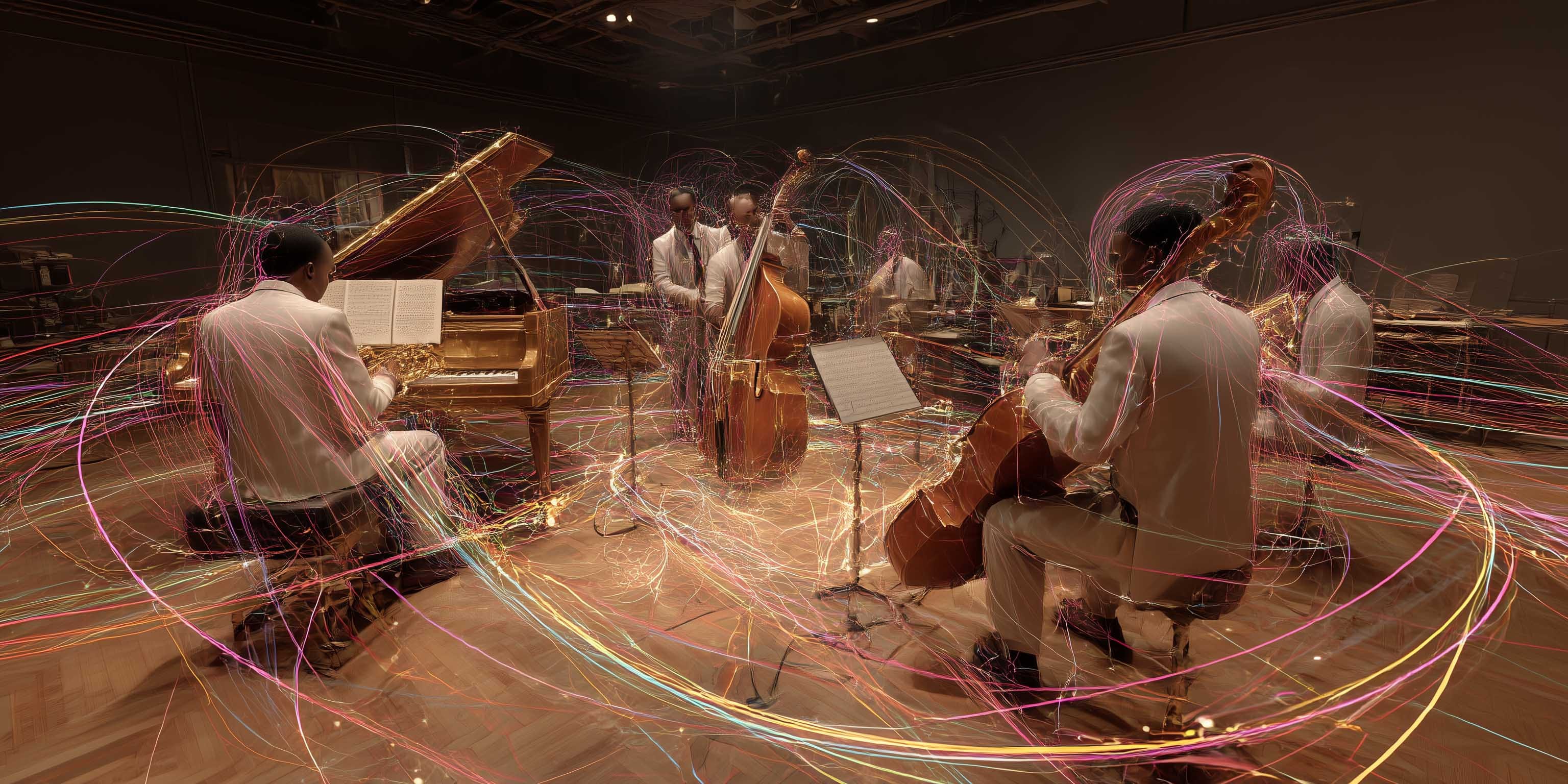
The same goes, on these theories, for a conscious mind.
What makes ‘you’ one subject is that the parts of your brain handling vision, hearing, memory, decision and so on can send signals around a loop and get a reply within a tight window, perhaps a few tenths of a second, so they don’t fall out of a shared present. Your unified experience, within this, is the fact that the circular conversation manages to finish its own sentences before the world moves on. Slow that conversation below a critical threshold, or sever one leg of the loop entirely, and you no longer have one perspective. You have fragments that can’t hear each other in time.
The hidden role of geometry
In everyday life, it seems obvious that whether a system is one thing or many depends entirely on how it’s built.
A brain feels like one mind because it’s small and densely wired. A swarm of drones feels like many agents because it’s scattered and loosely connected. The physical arrangement seems to settle the matter. But here I argue that this assumption is parochial: it quietly ignores the way spacetime itself decides which signals can close a loop in time. The architecture matters, yes, but so does the shape of the universe around it.
Relativity says that not all routes through the universe are created equal.
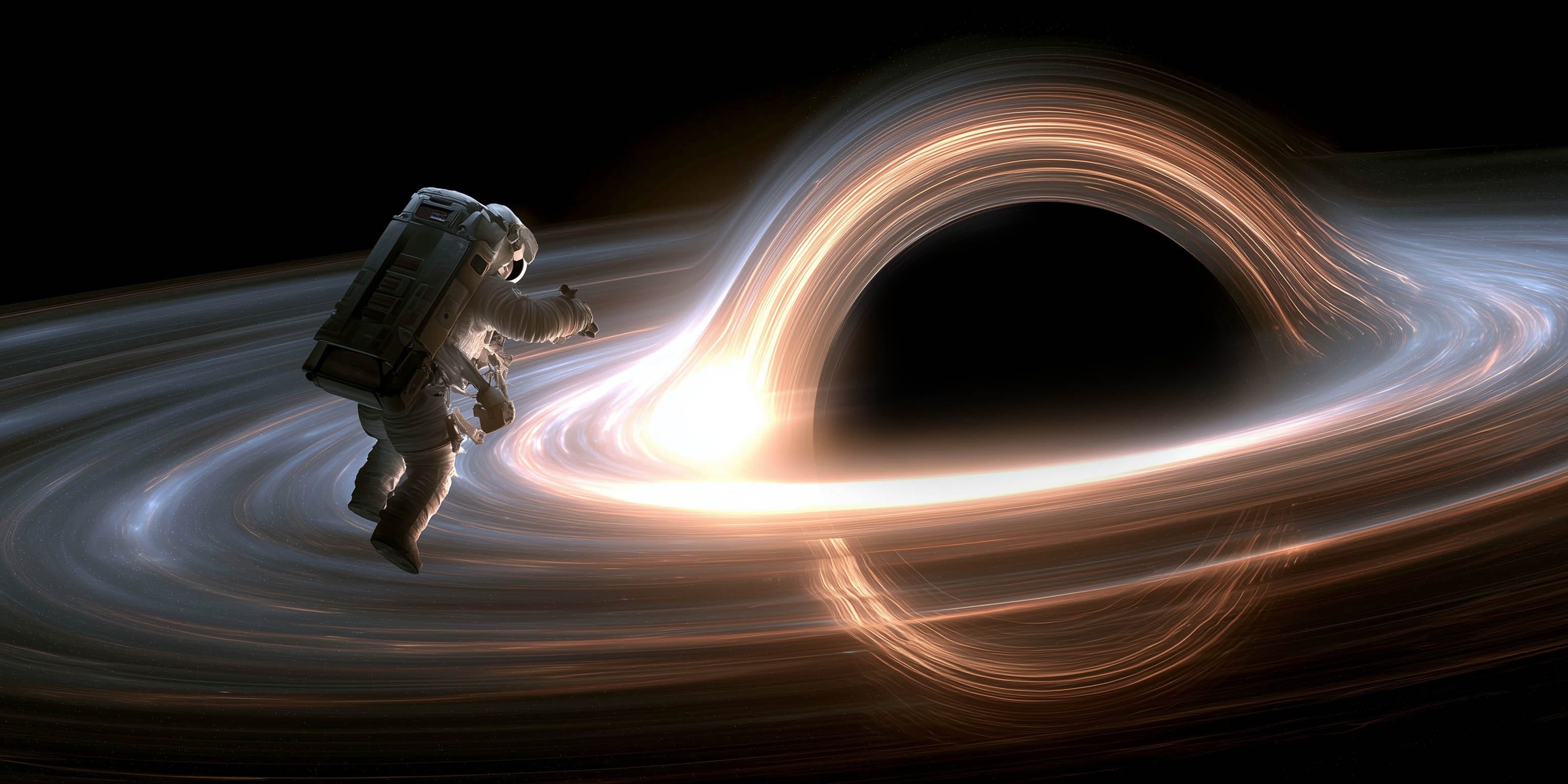
In regions with strong gravitational fields or rapid expansion, there can be boundaries that allow signals to cross one way but not the other within any finite time. A black hole event horizon is the most famous example: from just outside, you can send light inwards; from just inside, no light can ever make it back out.
For small black holes, the tidal forces here would tear you apart before you noticed, but for truly gigantic ones, millions or billions of times the Sun’s mass, the horizon region can feel locally gentle. You could drift through it weightless and intact, your neurons still firing normally, while the global causal structure of the universe quietly changes around you. Nothing breaks. The geometry just stops permitting certain return paths.
This mismatch opens the door to something fascinating.
A system can keep all its local machinery running smoothly, neurons firing, chips switching, interactions evolving normally, while the surrounding geometry makes it physically impossible for certain feedback loops to close inside the narrow window that kept it acting as one. The substrate machinery, both biological and non-biological, survives. The parts still work.
But the universe no longer gives that substrate enough room, in spacetime terms, to finish its own round-trip in time. Signals go out, but the echoes can’t return before the coherence window expires. From the point of view of any theory that equates unity with fast mutual contact, this isn’t a minor annoyance or a practical constraint. It’s a structural veto. The geometry itself says no.
The core: the smallest circle of ‘we’ that makes a ‘me’
This investigation introduces the ‘reciprocal coherence core,’ a tool designed for greater precision.
Stripped of jargon, the core is the smallest circle of parts that must stay in active, three-dimensional contact for there to be a single point of view on the world. It’s the essential band inside the wider orchestra, the minimal loop of feedback that keeps the performance hanging together. Not every neuron or chip needs to talk to every other one, but there has to be some irreducible circle of mutual influence that can complete its conversation before time runs out.
What does this core need to survive? Two things matter.
First, it must be reciprocal. Each part must not just influence others but be open in turn to being influenced back, so that true feedback loops exist rather than mere one-way broadcasts. A loudspeaker announcing to a crowd isn’t enough. There has to be genuine back-and-forth, a conversation where everyone can answer as well as speak. It must have multi-directional degrees of freedom in time and space.
Second, it must be fast enough. Those loops must close within whatever time window the theory deems essential for a coherent update. For brains, that might be tens or hundreds of milliseconds, the timescale on which your visual cortex and decision-making regions can exchange notes and settle on a unified ‘now’. For other systems, the window might be different, but it’s always finite. Infinity doesn’t help you here. The loop either completes in time or it doesn’t.

Zoom out from the details, and the picture is simple.
Take any theory that says ‘a unified self exists when there’s some minimal heart of components keeping this kind of conversation going’. Now ask a hard question: given the laws of relativity, in which regions of spacetime can such a core survive, and in which regions will curvature or one-way boundaries break its loops or stretch them beyond their time budget?
The answer matters because it determines not just where minds can exist, but where anything counting as ‘one thing’ can hold itself together through reciprocal information flow.
The answer isn’t the same for every theory.
Some insist that the unitary subject is spread across very large networks, whole swathes of cortex or distributed server farms. For these, a core must always be relatively big and will run into geometric trouble sooner. The moment the system straddles a one-way boundary, the core is forced to split.
Others allow that a subject might be realised by a compact loop buried somewhere in the architecture.
In those cases, the core can retreat into a small, geometry-protected domain and outlast the destruction of the wider system, like a seed surviving the collapse of the tree. Unity persists even as the periphery falls away, at least for a while, until curvature squeezes even the compact loop too tight.
The framework doesn’t declare which theory is right. It acts more like a test, revealing which kinds of unity would be fragile or robust in the face of the universe’s causal structure.
Two selves in one fall, revisited
Seen through this lens, the earlier black hole thought experiment becomes less of a one-off curiosity and more of a worked example.
Imagine again the human brain drifting slowly through the horizon of a supermassive black hole.
Locally, nothing spectacular happens. The person doesn’t feel a jolt or hit a fiery wall. Their neurons keep firing, their thoughts keep flowing, their body stays intact. But globally, something quiet and irreversible has occurred. Any signal that leaves the part of the brain now inside the horizon can never return to the part still outside. The geometry has inserted a one-way valve into what used to be a two-way conversation.
For integration-based theories, that one-way gate matters.
While the brain straddles the horizon, there’s a brief window in which the previously single, global web of fast feedback splits into at least two islands of strong connectivity. An interior island, which still receives inputs from the outside but can never reply. An exterior island, which continues to chat within itself but slowly loses access to more and more of its former partners as they cross inward.
Each island still contains its own core: a minimal circle of parts able to sustain a unified perspective by the theory’s own lights.
The strange consequence is that, on these theories’ own terms, there’s a period during which what was once one mind now supports two distinct, coexisting subjects, both descended from the same original system. One is dying as it loses nodes to the inward drift. The other is receiving orphaned signals from a conversation it can no longer join.
But the newer analysis refines this story.
The core may be smaller and more adaptable than the original global network. It can, in principle, retreat into a compact loop that remains fully on one side of the horizon for a few cycles, preserving unity even as the rest of the system fragments around it. For such theories, immediate mind-splitting isn’t inevitable the moment any piece crosses. It depends on whether the heart of the system itself is forced to straddle the one-way line, or whether it can huddle entirely in one region while the periphery falls away.
That distinction lets us sort theories into rough types.
Those whose favoured cores are inevitably spread out and geometrically fragile. Those whose cores are compact but time-sensitive: they can retreat, but eventually the curvature will squeeze even their loops too tight. And those whose cores are effectively pointlike and immune to anything short of local destruction.
Different theories of mind, it turns out, have different geometric profiles.
When a quantum computer ‘loses itself’ at the horizon
Brains aren’t the only systems built from delicate feedback.
Modern quantum computers are held together by a similar pattern of loops, but in a different register. They face the same geometric constraint, just with stranger components.
At a rough, non-technical level, a quantum computer works by encoding information in qubits.
These can exist in mixtures of 0 and 1 and can become entangled, so that changing one affects the others in correlated ways. This exotic state is powerful but fragile: interactions with the environment introduce errors that quickly scramble it. To keep a ‘logical qubit’ intact long enough to perform a computation, engineers encode its information across many physical qubits and continuously check for errors using helper qubits called ancillas.
Those checks follow a familiar pattern.
First, the data qubits imprint a signature of any errors onto the ancillas. Second, the ancilla measurements, now converted into ordinary bits, travel to a controller. Third, the controller sends back classical correction commands to the data qubits. This three-step cycle must repeat faster than the errors accumulate, and crucially, it depends on classical information going out and coming back in a feedback loop.
The ‘unity’ of the logical qubit, its identity as a single protected object, is therefore not just a matter of the underlying quantum state.
It’s a property of the whole extended system: data qubits, ancillas, controller, and the channels that let them talk to each other quickly enough. Break that loop, and you no longer have one protected computation. You have fragments that can’t correct each other.
Now imagine distributing such a quantum code across a region about to be sliced by a one-way boundary.
At the microscopic level, nothing special happens to the individual qubits as they drift across an event horizon. Local quantum evolution remains smooth, in line with the equivalence principle. But from the perspective of the error-correcting scheme, something fatal has changed. Syndromes generated inside the horizon can still be sent outward. Corrections generated outside can never reach back in. The core feedback loop the code relies on is broken in half.
From that point on, the logical qubit cannot be maintained as one error-corrected core spanning both regions.
The global quantum state may still be entangled across inside and outside, but there’s no longer a single operational ‘self’ in the engineer’s sense, no single protected degree of freedom that can be interrogated and controlled as one entity. Once again, geometry has quietly dictated the limits of unity. What looked like one system in flat spacetime becomes, in a curved spacetime with one-way cuts, a pair of only partially coordinated halves.
The same analysis can be run, in more mundane form, on distributed classical systems.
A planet-spanning AI whose sense of self (if that exists at all) depends on error-corrected, high-bandwidth loops between distant data centres may see its unity degrade if those lines become heavily delayed or effectively one-way. Spacetime geometry is just an extreme, principled version of a more familiar problem: when response times blow up or return paths vanish, large systems lose their ability to act as single agents.
Where the universe draws the line
What emerges from all of this is not a new positive theory of consciousness, but a constraint on a broad family of existing ones.
If unity is defined, diagnostically, by the presence of some minimal core of fast, reciprocal contact, whether in a brain, an AI or a quantum code, then the question ‘Is this one subject or many?’ becomes inseparable from a more physical question: ‘Does the surrounding spacetime still allow that core to close its loops in time?’
In almost all the situations we care about day to day, the answer is trivial. Human brains and their tools are tiny compared with the scales set by cosmological horizons and black holes, and signals inside them complete their round trips long before geometry has a chance to interfere. The universe, in effect, is being generous. It gives us a wide margin in which to ignore curvature and treat unity as a matter of wiring diagrams alone.
But these thought experiments and models show that generosity has limits. In sufficiently extreme regions, geometry starts to bite. There are configurations in which substrate remains intact, local laws hold, and yet the loops that defined a subject as one system fail to close within their allotted window.
Beyond that point, these systems can no longer truthfully claim to be ‘one of themselves’.
The self isn’t just implemented in spacetime - it’s carved out of it.
But this raises a question the analysis cannot yet answer. If dimensional structure determines where unified perspectives can exist, what role does that unity play in maintaining the dimensional structure itself? The standard view treats geometry as a pre-existing stage on which consciousness might or might not appear, subject to whatever constraints the stage imposes.
Yet the reciprocal coherence core - the minimal loop that must close to sustain a single perspective - is itself a dimensional relationship. It requires specific geometric conditions to persist: causal paths that permit return, timing windows that allow completion, and topological structures that enable genuine feedback rather than one-way broadcast.
Perhaps the boundary isn’t as sharp as we assume. Perhaps what we call a ‘self’ isn’t merely permitted or forbidden by geometry, but participates in the very coherence that allows dimensional structure to hold together at all. The mathematics shows us where unity ends when geometry breaks its loops. It doesn’t yet tell us whether the capacity for such loops, for perspectives that can finish their own sentences, is itself an ingredient in how dimensions remain stable, coherent, accessible.
The universe doesn’t write boundary lines around selves with bright paint or sharp walls. It shapes them indirectly, by allowing or forbidding the completion of feedback cycles in finite time. But if those cycles are what stitch dimensional structure into a coherent whole, then consciousness may not be an accident of arrangement. It may be how the universe maintains dimensional integrity from within.
Links